
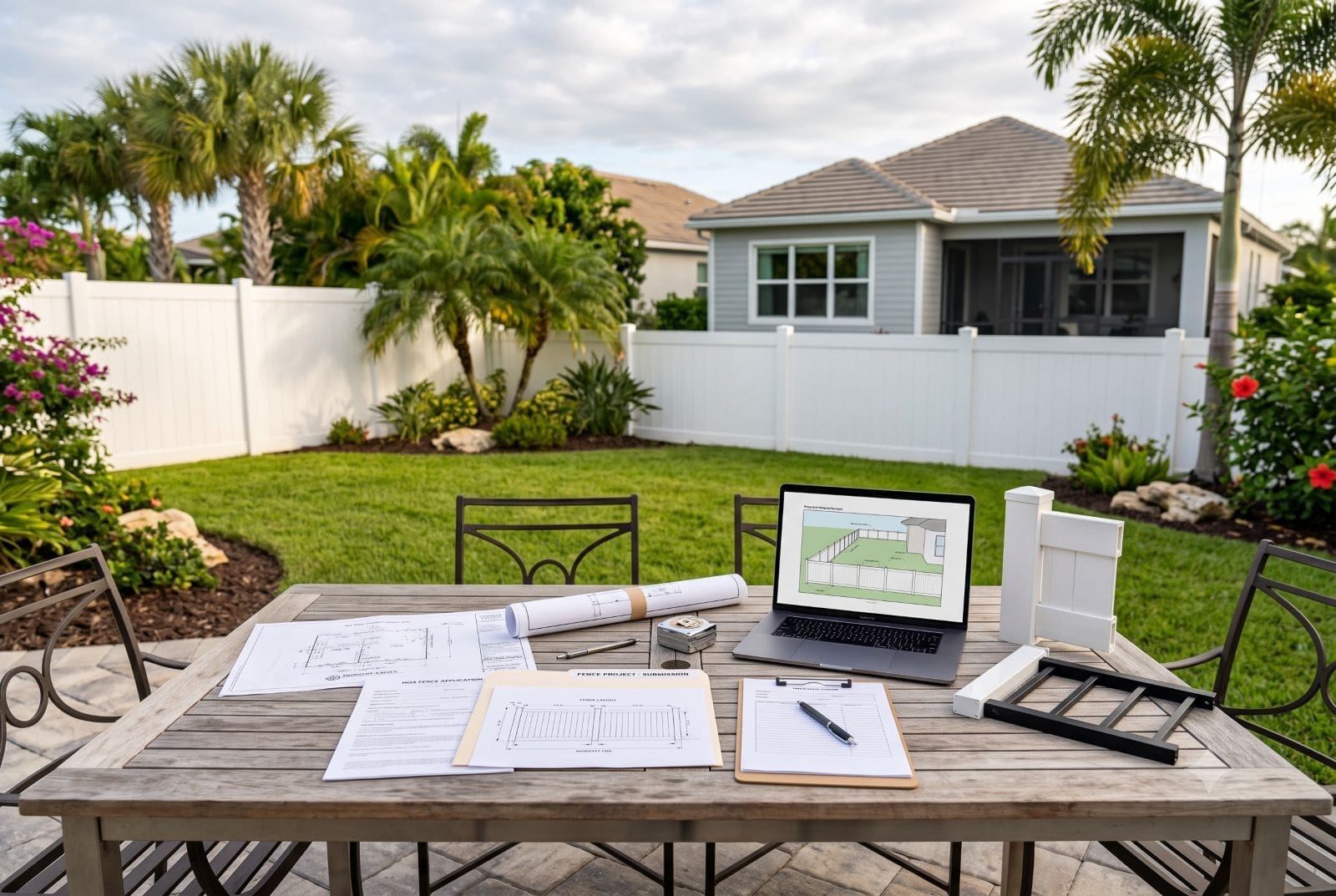
Getting HOA approval for a fence stops more Florida homeowners in their tracks than the installation itself. Between gathering documents, interpreting architectural guidelines, and waiting on committee decisions, the process can feel like a second job. This post walks you through exactly what HOA fence approval requires in Florida, what causes delays, and how to avoid the mistakes that send applications back to square one.
Already know what you need? Request a free quote from Fence Outlet and we’ll get your HOA packet started.
What Does HOA Fence Approval Actually Require?
HOA fence approval in Florida typically means submitting your signed contract, a property survey showing fence placement, photos or specifications of the fence style, and proof that your contractor is licensed and insured.
Some architectural review committees also want color samples, material specs, or a neighbor notification form. Requirements vary by community — which is why homeowners who’ve never been through the process often miss something and lose a full review cycle waiting for a resubmission.
The list is manageable when you know what to include.
What’s in a Complete HOA Fence Approval Packet
Getting HOA approval for a fence starts with a complete submission. Miss one item and your application goes back to square one.
Your approved contract — showing fence type, dimensions, material, and color.
A marked property survey — HOAs want to see exactly where the fence sits relative to property lines and easements. An unmarked survey isn’t enough.
Photos or specifications of the fence — style, height, and color all need to be clearly documented. Vague submissions get rejected.
Contractor’s certificate of insurance — proof your installer carries liability coverage.
Contractor’s business license — confirms you’re working with a licensed, legitimate company.
Choose Your Material and Style Before You Sign Anything
This step belongs before the HOA fence approval process begins — not after.
Florida HOAs vary widely on approvals. Vinyl and aluminum clear the bar in most Central Florida communities. Wood is common but often restricted to specific styles. Chain link is outright prohibited in many master-planned neighborhoods. Colors matter too — white and earth tones for vinyl, black or bronze for aluminum are the most universally accepted finishes.
Pull your CC&Rs and architectural review guidelines before selecting a fence. Look for the approved materials list, permitted heights, and color restrictions. Choosing a style your HOA won’t approve and having to reverse course is an expensive mistake.
Why HOA Fence Approval Gets Delayed in Florida
The most common reasons aren’t complicated — they’re avoidable.
Incomplete packets are the biggest culprit. Submitting everything except the insurance certificate, or using an old survey that doesn’t reflect a recent addition, gets your application tabled until the next meeting — which can be 30 or more days out.
Style violations are the second most common issue. Pick a fence you love, sign a contract, then discover your HOA only allows white vinyl — not the tan one you ordered. That’s an expensive reversal.
Starting installation before written approval is the worst outcome. Florida HOAs can require removal of a non-compliant fence at your expense. A verbal thumbs-up from a board member is not approval. Get it in writing before any work begins.
How Fence Outlet Handles HOA Approval for You
Once you sign a contract with Fence Outlet, we put together a complete HOA fence approval packet at no additional cost as part of our professional installation service. It includes your approved contract, a marked survey, fence photos, our certificate of insurance, and our business license — everything your association typically requires.
With 8 locations across Florida and over 30 years serving Central Florida communities, the documentation requirements are familiar territory. That experience means fewer back-and-forth delays and a smoother path from approval to installation.
You handle the submission. We handle making sure you walk in with everything they need.
How Long Does HOA Fence Approval Take in Florida?
There’s no statewide deadline written into Florida HOA law — the timeline that governs your application is whatever your declaration specifies. Many Florida HOA declarations include a deemed-approval clause, typically running 30 to 60 days from a complete submission, meaning the application is automatically approved if the board doesn’t act in time. Check your CC&Rs for the specific language that applies to your community.
In practice, communities with active boards and dedicated property management often turn HOA fence approval around in two to three weeks. Others that meet monthly may take the full cycle.
That timeline assumes a complete, first-time submission. Incomplete packets or style violations reset the clock. Submit early — don’t wait until the deadline approaches.
What If Your HOA Denies the Application?
Denials aren’t the end of the road — and the HOA fence approval process allows for resubmission.
HOAs are required to provide a written reason for denial. Most come down to one of four things: wrong material, wrong color, incorrect height, or incomplete documentation. Address the specific issue and resubmit for the next review cycle.
If a denial seems unreasonable, Florida Statute 720.3035 makes clear that HOAs can only deny applications based on standards specifically stated in their governing documents — not on subjective preference. If you believe your application was wrongly rejected, Florida’s Department of Business and Professional Regulation provides information on dispute resolution options available to homeowners.
What to Do While You Wait for HOA Fence Approval
Use the waiting period productively. Confirm your fence line with your neighbor if you share a boundary — disputes over placement after installation are common. Check whether your project also requires a local building permit. In Florida, HOA approval and municipal permitting are separate processes, and most counties require both.
Visit any of our 8 Florida locations — Orlando, Oviedo, Daytona, Melbourne, Tampa, North Port, Port Richey, and Jacksonville — or request a free quote online to get your project moving.